
Research on "Interfacial Microbial Engineering" and "Wastewater Treatment and Bioremediation"

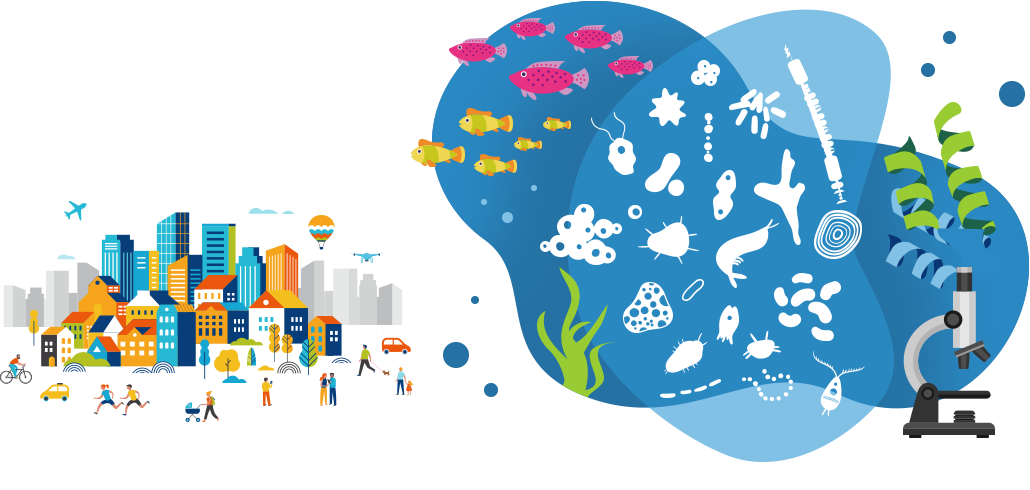
Our research target is microorganisms, especially unicellular organisms known as bacteria. We focus on two major themes, "interfacial microbial engineering" and "wastewater treatment and Bioremediation,” and are involved in everything from basic research to practical applications.
About Hori Lab.

堀 克敏

In our laboratory, we conduct basic research on the structure, function, and interaction with the keywords of "microorganism", "cell surface", and "interface". Based on the basic research, we aim to create a field of "Interfacial Microbial Engineering" that will expand new technologies to lead to green innovation.
In recent years, the microbial technology has advanced dramatically, and more efficient biological treatment technology has developed by using new materials and integrating with other technologies. In our laboratory, we also continue our research on wastewater treatment and bioremediation using microorganisms, aiming for social implementation of new technologies.

News

Aug. 21, 2026
The results of our collaborative research have been published in the ACS Synthetic Biology.
Enzymatic post-modification modulates hierarchical structure and dynamics in self-assembled peptide fibers
Aug. 21, 2026
Dr. Shogo Yoshimoto, Assistant Professor, received the Outstanding Presentation Award in the Chemical Biotechnology session of the 20th International Biotechnology Symposium and Exhibition (IBS2026). Congratulations!
Aug. 6, 2026
A review article from our laboratory has been published in Biotechnology and Bioengineering.
Artificial cell catalysts for biotransformation: Design principles and process integration
Jun. 10, 2026
The results of our collaborative research have been published in the Journal of Chemical Information and Modeling.
Synergistic protein–protein and protein–lipid interactions drive SARS-CoV-2 envelope assembly
May 21, 2026
Our research results have been published in ACS Synthetic Biology.
Bottom-up creation of virus-like particles via post-insertion of protein–lipid conjugates

News Archive

Nagoya Univ. Venture

YouTube

Department of Biomolecular Engineering, Graduate School of Engineering, Nagoya University
Hori Laboratory
Room 710, Nagoya University Graduate School of Engineering, Faculty of Engineering 1,
Furo-Cho, Chikusa-Ku, Nagoya, Aichi, 464-8603, Japan
TEL:052-789-3339 FAX:052-789-3218